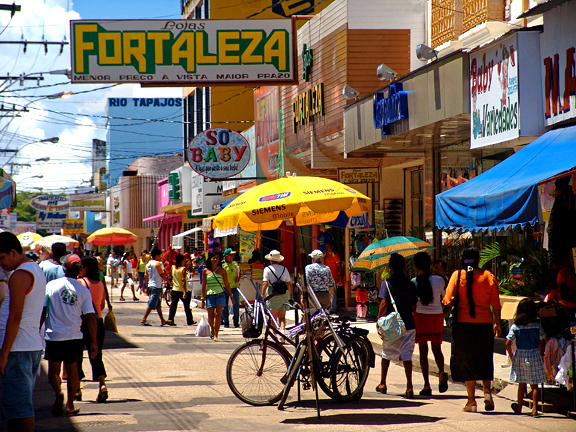
The population of Brazil, as recorded by the 2008 PNAD, was approximately 190 million (22.31 inhabitants per square kilometer), with a ratio of men to women. of 0.95:1 and 83.75% of the population defined as urban. The population is heavily concentrated in the Southeastern (79.8 million inhabitants) and Northeastern (53.5 million inhabitants) regions, while the two most extensive regions, the Center-West and the North, which together make up 64.12% of the Brazilian territory, have a total of only 29.1 million inhabitants.
Most Brazilians descend from the country's indigenous peoples, Portuguese settlers, and African slaves. Since the arrival of the Portuguese in 1500, considerable intermarriage between these three groups has taken place. The brown population (as multiracial Brazilians are officially called; pardo in Portuguese) is a broad category that includes Caboclos (descendants of Whites and Indians), Mulattoes (descendants of Whites and Blacks) and Cafuzos (descendants of Blacks and Indians). From the 19th century, Brazil opened its borders to immigration. About five million people from over 60 countries migrated to Brazil between 1808 and 1972, most of them from Portugal, Italy, Spain, Germany, Japan and the Middle-East.
In 2008, the illiteracy rate was 11.48% and among the youth (ages 15–19) 1.74%.
Roman Catholicism is the country's predominant faith. Brazil has the world's largest Catholic population. According to the 2000 Demographic Census, 73.57% of the population followed Roman Catholicism; 15.41% Protestantism; 1.33% Kardecist spiritism; 1.22% other Christian denominations; 0.31% Afro-Brazilian religions; 0.13% Buddhism; 0.05% Judaism; 0.02% Islam; 0.01% Amerindian religions; 0.59% other religions, undeclared or undetermined; while 7.35% have no religion
The largest metropolitan areas in Brazil are São Paulo, Rio de Janeiro, and Belo Horizonte — all in the Southeastern Region — with 19.5, 11.5, and 5.1 million inhabitants respectively.
The official language of Brazil is Portuguese which is spoken by almost all of the population and is virtually the only language used in newspapers, radio, television, and for business and administrative purposes. Brazil is the only Portuguese-speaking nation in the Americas, making the language an important part of Brazilian national identity and giving it a national culture distinct from those of its Spanish-speaking neighbors.


 The most popular sport in Brazil is football (soccer). The Brazilian national football team is ranked among the best in the world according to the FIFA World Rankings, and has won the World Cup tournament a record five times. Basketball, volleyball, auto racing, and martial arts also attract large audiences. Others sports practiced in Brazil are tennis, team handball, swimming, and gymnastics that have found a growing number of enthusiasts over the last decades. Some sport variations have their origins in Brazil: beach football, futsal (indoor football) and footvolley emerged in Brazil as variations of football. In martial arts, Brazilians developed Capoeira, Vale tudo, and Brazilian Jiu-Jitsu. In auto racing, three Brazilian drivers have won the Formula One world championship eight times.


 Brazilian art has developed since the 16th century into different styles that range from Baroque to Romanticism, Modernism, Expressionism, Cubism, Surrealism and Abstractionism.
 Brazilian cuisine varies greatly by region, reflecting the country's mix of native and immigrant populations. This has created a national cuisine marked by the preservation of regional differences. Examples are Feijoada, considered the country's national dish; and regional foods such as vatapá, moqueca, polenta and acarajé. Brazil has a variety of candies such as brigadeiros ("brigadiers") and beijinhos ("kissies"). The national beverage is coffee and cachaça is Brazil's native liquor. Cachaça is distilled from sugar cane and is the main ingredient in the national cocktail, Caipirinha.